Your
Questions
NOTE: Even though we have traveled to many fire departments and communicated with hundreds of fire service people, all over the world, we will undoubtedly omit terms and traditions. If you have a question or know of something we have left out, please help me make this site more accurate by letting us know.
Here
are some of the questions we have received. The answers for all are
below. Just click on the one you want.
Can't
find what you are looking for here?
Be sure to
try our Glossary page.
Is
there any truth to the belief that a full moon
makes busier nights for emergency workers or hospital
ERs?
In
a word, NO. There have been countless
studies on this myth that show there to be no correlation
between busy nights and a full moon.
Before
everyone writes us emails, please read the following.
Full
Moon Effect.
What
is a "Wet down Ceremony"?
This
is a ceremony to put a new piece of apparatus in
service. Here is what happens.
1.
The chief, and other esteemed people, photographers
and etc. are gathered at the station along with the
new and old apparatus.
2. The old, (retiring) piece of apparatus is PUSHED out of the station.
3. The bell is removed and installed upon the bumper of the new apparatus.
4. The new apparatus is ceremoniously wet down
5. Sometimes there is a special ringing of the bell and perhaps the station
speakers are opened, at all stations, to announce the event.
5. The new apparatus is PUSHED back into the station to start its life as a
member of that department.
Where
did this tradition come from? Here is were we have
to make some assumptions and draw some conclusions.
The
pushing probably goes back to the use of horses.
They probably wouldn't hook up the horses for this,
for several reasons. The "wet down" may
go back to the christening and naming of fire equipment.
(This is talked about this on the
history page.) The moving of the bell is a great
tradition. The bell should stay with the company
and be passed down forever. The bell could be hundreds
of years old someday.
Before you think negatively about this practice,
please consider this. Traditions are very important
in the fire service. They are how we pass down the
pride and commitment to those who follow us. In this
case, a photo of the crew, with the new apparatus
is placed on the wall of the station and becomes
a part of the heritage of that company. It might
be fun to see what the captain looked like twenty-five
years ago when they put that "old" truck
in service, when he was just a firefighter, but it
is more than that. These traditions are a link to
our past, and to our future.
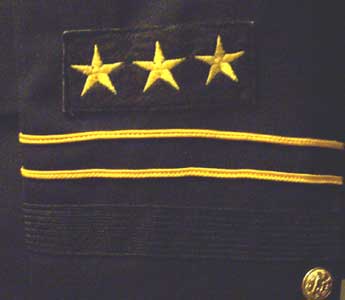
Captain
with 15 years service.
What
do the stripes and stars, on the sleeve, of dress blue uniforms signify or
represent?
This
is a very good question.
The
basic rule of thumb: Each star = 5 years of service.
The
stars can be actual stars or maltese crosses.
For
most fire departments, the stars (or crosses) signify time in
a fire department. Each star usually represents five
years. This often will depend upon the type of
department for which the person is wearing the uniform.
For example, if you were a volunteer for ten years
before becoming a paid firefighter you PROBABLY would
not have three stars on your uniform after five years
on the paid department.Many departments have
people who were volunteers before getting on. The
stars on their sleeves represent the number of years
on a paid department. We should probably
point out that it does not mean the number of years
on our department. If this were true then the chief
of most departments would often have few or no stars. This
is because they are often hired from other departments.
There
are probably all kinds of exceptions to this. There
are paid departments which are created from volunteer
organizations. Some VFD's may want their volunteers,
who are also paid firefighters to show their experience
on their blues. The variations are probably endless.
The
piping usually signifies the officer's rank. A lieutenant
is one stripe, a captain is two stripes, etc. It
is reflective of the number of "bugles" the
person wears.
The black band signifies that this person is an officer. Gold buttons are usually
just on officer's uniforms. In some departments, only senior officers get gold
buttons. A Lt. or non-officer may have silver buttons and stars. Some department might only give officers gold piping. Lower ranks might be blue or some other color. Chief officers
will usually have very wide gold piping. (See below.)
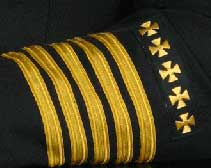
Sleeve on a chief's uniform.
Can
you explain the push or trend towards "4 man
staffing"?
This
is a popular and complex question. There are probably people better qualified to answer this question, but here goes.
There
are many paid departments that have already been
able to get their cities to pay for four people on
every piece of equipment. Some have had it this way
for decades. In areas where there is collective bargaining
and contracts are signed, this subject is often brought
up and dealt with. In cities without contracts, all
the departments can do is ask for more people. But
do we need them? You will find all kinds of positions
on this subject. There are many factors that suggest
that we do need four people on each piece of equipment.
Here are just a few of them.
- We
always work with another person. No one should
ever be alone. For this reason, three people is
still just one crew. Four people can be divided
into two crews. This means that the addition of
just one more person can result in twice the work
being done or twice the area being covered. There
have been extensive studies about this.
- Recent
changes in regulations like OSHA or NFPA
require that if two people go into a hazardous
environment,
or situation, that there needs to be two
people outside ready to rescue them. This is
often referred
to as "2-in / 2-out". Unless there
are four people on that first arriving piece
of equipment,
that crew will have to just wait until another
company gets there.
- In
the past, a theoretical score from the ISO (See
Glossary) usually determined a homeowner’s
insurance rate. Part of that score dealt with the number of personnel on hand. Now in many states the same insurance
companies set the rate based upon the actual fire loss
in a zip code. (See
ISO) The sooner firefighters can be on the
scene and can begin operations the less fire loss
there is. The amount of loss can be directly related
to the number of firefighters who get there early. So there might still be an impact on insurance rates by having more people, even if your rate isn't based upon ISO .
- We
want to save lives and property but we also want
everyone to go home at the end of the shift. Four people is just safer.
(See #2) Almost no one would argue that having
more people is not safer.
But
some would argue that there are other ways to put
more people early on the incident scene. One method
might be to create a "squad" of firefighters
that respond to every structure fire. This is usually
a vehicle, such as a suburban, equipped with SCBA,
some hose line, hand tools, etc. Usually this vehicle
is staffed with four firefighters, These units are
then stationed strategically around the city. Another
way is to equip and man MICU crews for firefighting
and dispatch them to structure fires. Some cities
have chosen to put four on a truck and leave three
on engines. Others have decided to do the opposite.
The variations are endless.
There
are those who don't think we need four man staffing.
There is the pride and tradition aspect. "We
did it with even less people 30 years ago." And
there are those who say that people who want four
man staffing are just "empire building".
They say that there are people who want to go to
meetings with other fire departments and brag of
the size of their departments. One might also suggest
that a chief wants a bigger department in order to
justify his own large salary. These statements or
excuses usually don't hold water. (Although it is possible that the "empire building" mentality
does sometimes exist.)
Why
do emergency services tie up traffic for so long?
Why do they block so many lanes on a freeway?
This is complicated.
Recent
federal mandates have prescribed that emergency scenes
need to be protected better than in the past. More
lanes will be blocked, for longer, in order to achieve
this objective. Another reason for delays in opening
freeways is this need to involved multiple agencies.
There are any number of circumstance where water
departments, medical examiners, water departments,
health departments and state or federal agencies
must be summoned and arrive before any work can be
done to open the roadway. For
even more information, on this subject, go HERE.
Why do fire stations have red lights on the front?
A question often received. In truth
it should probably be, "Why do some fire
stations have red lights on the front? The usual reply
is: "Ask the department where you see the red
lights. (And let me know.)"
The fact is that some do and some don't have red lights.
The lights could be there for a host of reasons.
- Some communities have just chosen to have red lights to signify a fire station.
- Perhaps it guides someone to where the night doorbell is.
- Some volunteer departments use a light (sometimes red) to indicate the location
of a phone to call 911. (Since these are mostly unmanned stations.)
- Some used lights to signal an alarm.
- Some indicated that the doors were about to open or close.
- There could be some local tradition.
If we imagine fire stations in old downtown areas, such a Chicago, Detroit, San Francisco, or New York, we can see them on streets that have almost no area between the doors and the street. Furthermore, fire stations were often in the center of the block. looking down the street, a fire house would look like any other business unless there was something to set it apart. Red lights served the purpose well to let people know it was an emergency facility and to possibly warn that horses or apparatus could bolt from those doors at any second. There are probably still many stations still located on the street curb in many U.S. cities.
When the population shifted to be more suburban in the mid- Twentieth Century, many fire departments discontinued the practice of red lights because fire stations had large signs, flagpoles and other ways of standing out.
Lewisville
Texas is a fire department known for being
traditional as well as progressive. The chief,
Rick Lasky, writes for fire service publications. He
has a book out about fire service history and tradition. He
is from the Chicago area so he has a background
in departments with long histories and traditions. We have been told that Chicago fire apparatus have red
and green lights because they had a fire commissioner
whose family was in the shipping business. (Albert
Goodrich. He served from 1927-1931.) These lights
were somehow transferred to the stations. So Chicago
stations may have red and green lights. (Good
Photo Here) Some smaller, Chicago, area departments
probably inherited chiefs from Chicago and they imposed
this tradition upon their new departments.
To support the assertion above we can refer to a Q & A trivia article in Fire Engineering magazine.
"Q: The Chicago Fire Department has many traditions. One is that a fire apparatus display a green warning light, usually on the officer's side of the apparatus. Why does it do that, and how did the tradition start?
A: A former CFD Commissioner was a boating enthusiast. He felt it made sense so on-scene commanders could determine the direction from which the apparatus was responding."
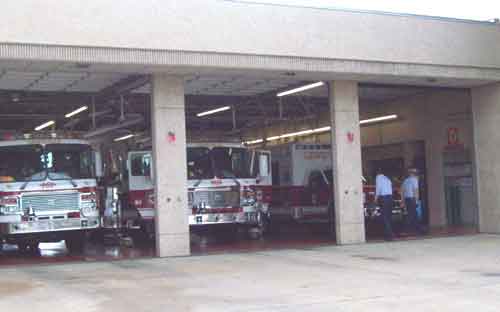
Lewsiville (TX) Central Fire Station 2008
The Chief
of this department explained that this was something that he had
asked for, since the day he
took
office.
He reaffirmed that these lights were to allow people to identify
the stations in the old days, in New England, when
there was a
zero setback for the old urban stations.
He also
talked about how these lights were, and still
are, associated with the old pull alarm
boxes in places
like N.Y.
If you
want to know why a particular department uses a red
light, I suggest you ask that department.
How do cities decide how many fire stations or firefighters they should have?
This is an excellent question. If only there was a simple answer.

North Bay, Ontario, Canada. Fire Station #1
It is often asserted that determining how many firefighters are
needed on duty is more of a political and financial
decision than just about anything else. We would
all like to have a fire station on every corner,
but that is just not possible for many reasons. There
are many factors involved. In some states the firefighters
have the right to "collective bargaining".
In this process the firefighters and the city decide
upon a contract that defines the pay, benefits, responsibilities
and personnel strength of the fire department. In
much of the U. S. no such contract exists. City management
is free to do whatever they feel is best. This is
not to say that they can do anything they want. Cities
are still run by politicians or the people appointed
by politicians. If the citizens do not feel that
they are being properly cared for or that their tax
dollars are not being spent correctly, someone may
be held accountable. In most cases the fire chief
and sometimes the firefighters association will have
valuable input.
Cities
in the same general region of the country will often
be set up similarly. But the farther you are apart,
the greater the differences might be. Let's compare
four very different departments, Irving, Texas,
Newton County GA, North Bay, ON, and Manchester, New Hampshire.
These departments have a similar number of firefighters
and stations, yet they are very different in population
and land area.
Irving
TX - http://www.ci.irving.tx.us/fire/
- 11
Stations
- 11
Fire engines
- 4
Trucks
- 6
ALS MICU's (Ambulances)
- Just over 300 firefighters. (including EMS)
- Population
- Just under 200,000
- Land
Area - About 68 sq Miles
Manchester
NH - http://www.manchesternh.gov/CityGov/MFD/Home.html
- 10
Fire Stations
- 11
Fire Engines
- 5
Trucks (and some "Quads" and "Quints")
- No
MICU's (MFD apparently does not run EMS)
- About
250 firefighters.
- Population
107,000
- Land
Area - 33.9 sq miles
Newton
County GA - http://www.newtoncountyfireservice.org/
- 12
Fire stations (Some staffed with paid personnel,
some with volunteers.)
- 12
Fire Engines with some quints/trucks.
- No
MICU's (Hospital based county wide private EMS.
Note: 2 of these MICU's are quartered in County
stations.)
- 80
Paid FF's with 50+ Volunteers
- Population
served about 96,000.
- Land
area served about 278 sq miles.
North Bay, Ontario, Canada - http://www.cityofnorthbay.ca/fire/
- 3
Fire stations
- 3
Fire Engines with some quints/trucks.
- No
fire department MICU's (City based Emergency Ambulance Service.)
- 83
Paid FF's
- Population
served about 54,000.
- Land
area served 314.91 sq KM (121.6 sq mi).
As
you can see, there are big differences in the level
of protection each city has chosen. Or is there?
Irving -
1 Firefighter hired for every 638 citizens. 1 fire
station for every 17419 citizens
Manchester -
1 firefighter for every 428 citizens. 1 station for
every 9727 citizens.
Newton
County- 1 paid firefighter for about ever
1000 citizens. (But one paid and 1 vol. FF for
every 500 citizens) 1 Sta. for every 6417 Citizens.
North Bay, Ontario - 1 firefighter for every 662 citizens. One station for every 18000 people.
On
the surface it appears that Irving has about half
the protection that Manchester has. Irving has twice
the land area, and almost twice the population. Newton
county has much more land area but half the population.
And yet they have about the same amount of firefighters.
If you remove the EMS personnel needed to staff 6
MICU's, from Irving's stats, you see even more similarity
in the number of firefighters hired. Both Manchester NH, and North Bay, ON, have four shifts/platoons so the number of people actually on duty must be divided by 4, instead of three, as in Irving or Newton county. When you compare
Rochester and Irving to Newton County there appears
to be differences, but are as drastic as
it may first seem? Are there valid reasons for these differences? I am sure that
the government of all these cities think so. You have
to consider many factors.
These
are very different fire departments from very different communities. Manchester
is older. Irving has some of the toughest fire codes
in the nation. Newton Co. is spread out. Manchester
has collective bargaining. Irving has an excellent
water supply system for fire hydrants. Manchester
is in the north east where winters are harsh and
keeping warm, in older buildings can be a cause for
fires. In parts of Newton Co. and North bay, obtaining water might be a
problem. There are probably other huge differences
as well. A large number of the structures in Manchester
are buildings that are three story, wood frame and
four feet apart. When one catches on fire you can
often lose three. It's also just a fact of life,
fire departments in the north east are very different
than those in the south or west. I am sure that all
four city governments are trying to do their best
with regard to protecting it's citizens. Not only
that, but the fire chief of each department certainly
has a say in what is needed to protect the city.
The money available is another unfortunate fact.
One must consider the tax base and the cost of living
in each area. I have no idea what the tax base of
Manchester is. If you consider that Irving and Newton
County works 24/48 and Manchester is 24/72 and North Bay used a four platoon 10/14 schedule, the ratio
of people on duty to population becomes not so dramatic
of a difference. Irving can have almost 100 people
on duty while Manchester will have about 50 each
day. Newton County may only have about 20 people
on duty but they have a reserve of up to 75 volunteers
to assist them. North Bay has 20 people on duty every day. If you look at it this way then fire
protection is about the same.
North Bay - 1 firefighter on duty for every 2700 people. (Without fire dept. EMS)
Irving - 1 firefighter for every 2000. (With the EMS service.)
Manchester, NH - 1 firefighter on duty for every 1725 people (W/O EMS)
Newton County, GA - 1 (paid) firefighter on duty for every 2300 people (w/o EMS) (But Newton Co. has as many volunteers as paid firefighters.)
It is easy to see that there are may factors that go into the decision of what is the appropriate number of firefighters a department should have available. The types of buildings, the climate, if EMS is run by the fire department, the work schedule. Some people will attempt to apply a "rule of thumb" that says, "One firefighter for every 1000 people in population." This simply does not fit most fire departments.
When
we try to determine how many firefighters we need,
we also have to consider all the other ways that
cities have tried to accomplish that number. This
includes volunteers and PSO departments.
For years the ISO was
a big factor in deciding staffing for fire departments.
In many states this is no longer the case. Georgia
is one of the states where the state government requires
ISO to be a factor in the insurance rates and therefore
they have major influence on fire department staffing
and equipment.
Why do firefighters work 24/48, or other strange hours?
This question has both a simple answer and a very long one. I will do my best.
Simple Answer - Because they can. U.S. Labor laws, which
regulates when you have to pay overtime for working more than 40 hours a week,
exempts firefighters.
Long answer - Many fire departments DO NOT work 24 /48.
Some states require the paying of overtime (1.5 X reg. pay) for hours over
40, even for firefighters. Some states have unions and collective bargaining
and the firefighters have a contract that gives them something other than
24/48.
There
are many kinds of schedules.
- 12/12 for so many days then a certain number of days off.
- 10 /14 You work so many days consisting of 10 hours shifts and then some
days of 14. (Usually nights.)
- Four - 10 hour shifts a week.
- Even Five - 8 hour days
- Some even work 24/72. RARE. (But that would be cool huh?)
- On the west coast you can find firefighters who work 24 on then 24 off for
a period then have a long time off.
- The Maui (Hawaii) fire department works 24/24 as above but they have one
station on the island of Lanai that is considered a remote station. Here they
work 3 days on and 6 days off.
- NEW! A few fire departments have either switched
to, or are considering, 48/96.
(2 days on 4 days off) For more information go to: San
Jose FD Local Union site on the subject (Here you can download a PDF.)
- Just about any combination is possible.
Some
departments have people who just work weekends. They
will work 40 hours just on Friday, Saturday and Sunday.
They will do this by working something like two 14's
and a 12 on those three days.
Federal law allows firefighters to work only 53 hours before it is required
that the employer pay "time and a half" for hours worked. If you
do the math you will see that, on average, a firefighter on 24/48 works seven
shifts in a three week period. This adds up to 56 hours a week. There are several
methods used to prevent those 3 hours of overtime. Although some cities just
pay it when it happens.
For
more information on how cities deal with these three
hours go to:
http://www.fireserviceinfo.com/fire/QA.html#kdays
What
do "chief's drivers" do besides drive
a car? Why do we need them?
This question probably refers to Battalion Chief's drivers.
At first glance it may look silly to have someone whose job it is to drive
a chief around. But in reality, the job(s) that a Battalion Chief is often
called upon to perform, is really a two person operation. Besides the day to
day logistical paperwork and time spent on the phone that takes up much of
the chief's time, there is the chaos of an emergency scene which requires a
great deal of communication and information coordination.
Daily
Operations- The Battalion Chief is really
the person who insures that day to day operations
are possible. Consider this: there are 168 hours
in a week. In most departments, staff officers,
such as higher chiefs, only work 40 hours a week.
For most of the time, the Battalion Chief is the
highest ranking officer on duty. Note: as mentioned
elsewhere on this site, the really large departments
might have district chiefs on duty 24/7, but that
is rare. He or she has to insure that all positions
are covered. For example, in just a few minutes,
before the oncoming shift starts and outgoing shift
leaves, the Battalion Chief must make sure that
there are enough people on duty. Does this sound
easy? Imagine having 50 people who work for you.
Each person has a very specific role and every
role must be covered. You might have one or two
extra people on some days, but what if too many
people call in sick at the last minute? What do
you do? Perhaps you can hire an overtime firefighter,
who is not a paramedic, but you need a paramedic
on an MICU. Do you get on the phone and hope you
can find a paramedic who can quickly come in? Do
you move four people around so you can finally
put that firefighter where you don't need a paramedic
and move the paramedic from his station to the
MICU station? This is just one job that a BC may
face every day, and the shift hasn't even started
yet. Schedules have to be planned in advance. Vacations
need to be scheduled and assignments need to be
considered. If a firefighter gets injured or a
vehicle has an accident, it is the Battalion Chief
who makes the initial investigation report. The
list of jobs and responsibilities can go on and
on. In some departments the Bat. Chief oversees
training. The Battalion Chiefs pretty much run
the fire department. Every detail of the battalion
is handled, in some way, by the BC. Sometimes a
decision is made to take an issue to a higher level,
but that is rare. The Chief of the Department is
on duty only 24% of the time, and yet he or she
has a large staff of people to help. The other
76% of the time the Battalion Chief(s) run the
department.
*
Please don't write us. We know that staff officers
have completely different, and very complicated jobs.
They are also usually on call for any large emergency.
The point is, that for day to day operations, the
BC is THE highest ranking person on duty, for most
departments. Shouldn't he have an assistant?
Emergency
Scenes- The average person probably can't
imagine the complexity of the situation at a fire or other emergency
scene. The command officer is bombarded with information
and communications. Decisions need to be made quickly.
The Incident Commander can't be spending all his
time writing down information, talking on the phone
or radio, and making decisions based upon that
information. In many cases there are three radio
frequencies that have to be monitored. A record
of who is where and what they are doing must be
kept. Once a decision is made, those units must
be informed of their assignments. These actions
take away the ability to manage other information
and make more decisions. But if the Incident Commander
has a "Command Technician" (or "CT")
to assist him, operations at command run much smoother.
Note: Like I say so often, different departments
may use different names for this person. They may
be known as a "Command Assistant" or
by other names elsewhere.
Command
Technicians are trained in communications
and organizational skills. This is a person who
must be able to take in information and organize
it, as well as, present it to command in a way
that makes sense. He needs to know the systems
and equipment of the command vehicle. Think of
the old war movies. Is the officer making the decisions,
the actual person who is carrying, and talking
on, the radio? Is the commander the one getting
information about units and drawing on a board?
No. The radio operator, even in a small unit like
a platoon, relays information to, or from, the
officer. The fire service works much the same way.
In the best, complicated, emergency scenes the
command officer may never talk on a radio. In really
big fire or emergency situations, you really need
two command technicians. You need one to organize
incoming information and one to talk on the radios.
In the really big operations, those that last for
a day or longer, command will assign people to
take care of command functions. He may assign officers
to Logistics, Public information, etc. He may assign
someone as a liaison to other agencies such as
law enforcement or the Red Cross. Each one of these
officers could probably use an assistant as well.
But in most situations, the Incident Commander
will cover all these functions. He or she will
talk to the Red Cross, the police department, the
media, call for assistance in many ways and make
decisions about actual operations. See why an assistant
is needed?
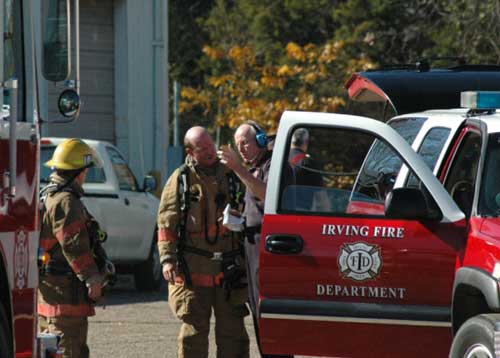
Ben Saladino Photograph.
In
this photo, the Command Technician is relaying instructions,
from command to an officer.
You can spot the "CT" because he is wearing the headset.
The Incident Commander is probably to the rear of this vehicle looking at information
or talking to someone else.
Cherry Picker?
You will often
hear Aerial Platforms referred to as "Cherry Pickers" by the news
media. We have spoken to several firefighters and we all agree, we have no idea
where this term came from and how the news media came to use it. We have never
seen platforms referred to as this in ANY fire service publication. Has anyone ever heard a firefighter refer to a "Snorkel" or other apparatus
by this name. If anyone uses this term one might suspect that it would possibly
be only "CHERRY GROWERS"! Note: There may have been a time when fire
departments borrowed agricultural equipment, for rescues, in some communities.
But how long ago was that?
What should I do when I encounter an emergency vehicle on the roadway?
If
the emergency vehicle has lights and siren on, you
should pull your vehicle to the RIGHT SIDE of the
roadway and STOP. You should signal as you do this, if possible.
Many people will stop their cars right where they
are. Every day we have to weave between vehicles
or go into opposing traffic because people do not
seem to know what they should do. It is also important
to note that many states have very strict laws regarding
what you should do with emergency vehicles on the
roadway. There are MANY states that prohibit you
from passing an emergency vehicle, with warning devices
on, at any time. Except on highways, you should stop
for emergency vehicles. We have people try to pass
behind and between us and our station, as we are
backing in, almost every day. Can you believe this?
We are backing up, with our lights on, and they are
driving behind us. Please keep this in mind. If an
emergency vehicle is stopped, in the roadway, with
it lights on, personnel are probably working around
it or are just about to bail off of it.
Why will you see a fire engine driving down the road, with lights and siren
on, and then just turn them off and go to the store?
Believe
it or not, we aren't just using our warning devices
to go to the store quicker. Emergency vehicles are
very often "disregarded" from runs. In
the case of a structure fire, several companies are
dispatched. When the first arriving unit "checks
out", they are often able to report that the
fire is out or perhaps it was a false call. In this
case all the other companies get to turn off their
lights and go back to the station. Very often we
will have the need to pick up something at the store
but we will "wait until we get out" to
go.
Can emergency vehicles change the traffic lights?
Yes.
Many cities have installed a system where emergency
vehicles can change a red light to green. Each vehicle
is equipped with a small light emitter. To the eye
this looks like a series of rapid camera flashes. A receiver
on the traffic light pole will sense the special
coded frequency of flashes and turn the light green for
that vehicle, and red for everyone else. These can
't be used just to get around town for several reasons.
Many of them are connected to the light and sirens.
It is not on unless everything is on. They also keep
a record of each use. It is possible, through data kept to determine which vehicle triggered the device at exactly what date and time. Contrary to what you might have seen on a recent episode of "Lie to Me" these aren't hand held devices the size of garage door openers.
More information: http://www.cedarcity.org/ccfd/news/opticon.htm
Why is it called a fire “plug”?
You
are correct to question this. They are really hydrants.
But terms and traditions linger in the fire service. Many
years ago water mains really had wooden plugs. During
a fire the firefighters would dig down to the main
and drill a hole to get water. After the fire a wooden
plug was driven into the hole. Firefighters tried
to remember where all the plugs were because it was
easier and quicker to knock out a plug than to drill
a hole. A fire fighter would simply use an ax to
knock the plug out. Sometimes all this would do is
fill a depression in the ground so people could scoop
up water in buckets. Later, water would be drafted
out of the mains. These mains were sometimes made
from wood or other material.
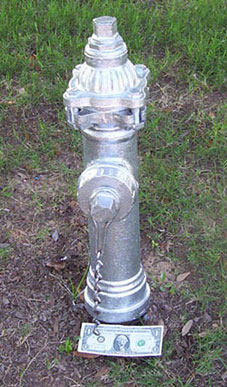
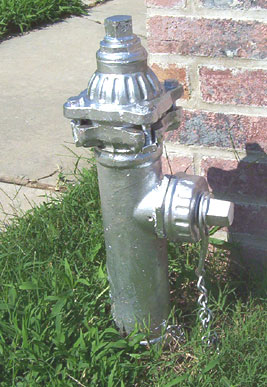
These
2 1/2 inch hydrants (?) were found in a residential
area in Flower Mound, Texas. So far only three of these hydrants have been found.
Update: The Fire Chief of this department sent us an email about these hydrants. Apparently they are installed on dead-end water mains to occasionally flush the system. If they didn't have them, sediment would accumulate. They are not intended for fire protection use.
Are
you into fire hydrant collecting? Do you want to
know what the colors mean? Do you, for some reason, want to know ANYTHING or EVERYTHING about fire hydrants? If so we recommend the following site:
http://www.firehydrant.org/
What is firefighter protective clothing made from and how does it work?
The "Turnout
Gear" is made from several layers of different
fabrics. These include: PBI, Kevlar, Nomex and others.
They form both a protective shell and thermo-insulating
barrier.
How do firefighters see in smoke?
It
depends. Often they simply don't. A great deal of
firefighting or searching is done by feel. The glow
off the fire or flames is sometimes all you see in
the beginning. There are devices that allow firefighters
to see in smoke quite well. But these devices are
usually not available to every firefighter on the
scene. They are usually for very specific purposes.
See, "Thermal Imaging Camera" in our glossary.
What is the difference between and “Engine” and a “Pumper”?
Not
much. These are usually just different terms for
the same thing in different parts of the country.
What is Overhaul?
"The
search for, and extinguishing of hidden fires."
What did those “tones” on the show "Emergency" mean?
The
speakers at each fire station would only come on
when a message was for one of the companies at that
station. This way personnel did not have to listen
to all the calls at all the other stations. The speakers
were activated by something probably called a "Plectron" system.
Each station's radio was sensitive to only two tones
and the interval between them. Think about it. If
you have just 7 notes, you have 49 variations of
tones. Add to that certain other features and you
can have a code for many different stations. Today
this is often done by the transmitting of a digital
signal that tells a station's radio to come on and
broadcast the message.
For
more about the show "Emergency" I recommend: http://emergency51.com/
To download and hear the "tones" or the theme song and more, go to: http://emergency51.com/sounds.html
What is in the breathing tanks? Is it just oxygen?
No.
It is the same air we all breath. If you can imagine
a container that is about 4ft X 4ft X 4ft, that is
about the amount of air that has been squeezed down
into a cylinder. Each tank is rated to be able to
supply 30 to 45 minutes of air depending upon it's
volume and pressure it is rated for. But this is
based upon no exertion at all. A fire fighter is
doing good to get 10-15 minutes from a tank at a
fire. Note: there are cylinders that hold more air and even some that contain less. The fire service is slowly moving towards higher pressure systems that have more cubic feet of air.
What do the horn shaped insignias you sometimes see on clothing or helmets
mean?
In
the early days, of North American fire departments,
orders were given to the troops, by officers, by
speaking through a device that resembled a megaphone.
These were very ornate brass horns. They were commonly
called “Bugles” or speaking trumpets.
This was the major means of communications on the
fire ground for over 100 years.
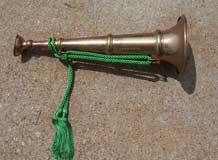
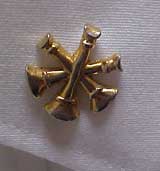
A "Bugle" and a type of Chief's collar brass.

Captain's
hat brass
Officers
were the only ones allowed to use this object so
a small pin in the shape of a bugle became a type
of rank insignia for officers. The more “bugles
on his collar” the higher the rank. An expression
still used today. See: Ranks
and Organization.
How do wildland firefighters put out forest fires with an ax, shovel, and a
chain saw?
It is amazing that people on the ground with such tools can help to control a forest fire. Wildland firefighting has become a specialty. These operations can last for days or weeks at a time. The skill to manage such an operation is a specialized discipline and requires a staff of trained competent specialist.
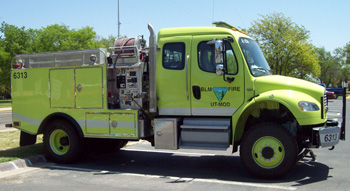
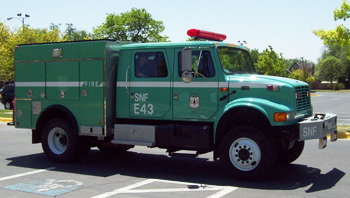
Special equipment and apparatus are also employed. The most spectacular might be the airdrops. Examples of other equipment designed for the job might include the two vehicles pictured below. One is a BLM fire crew vehicle, the other is a Forest Service engine.
Good
question! The following sites are suggested.
http://www.fs.fed.us/r6/siskiyou/fire1.htm (Excellent
Park Service Site on the subject)
http://www.lacofd.org/ (LA County
Fire Department)
http://www.fire.ca.gov/cdf/incidents/terminology.html (Calif.
Dept. of Forestry)
http://www.scancolorado.com/wildland_fire_terminology.htm (Colorado)
http://www.biscuitfire.com/wf_terminology.htm (Another
US Park Service Site)
http://www.nifc.gov/index.html (National
Interagency Fire Center)
How do firefighters know how many hose lines and fire trucks are needed to
control a fire?
There
are several methods and "Rules of Thumb" that
help us do this. The best methods involve experience
and pre-fire planning. It is not uncommon for an
officer to respond to several fires at the same apartment
complex in his career. Past experience can help him
or her decide what is needed on this or similar fires.
We also drive our districts and visit businesses
to establish plans for if a certain location has
a fire. Another method that helps is an accepted
mathematical formula for an estimate of the needed
fire flow. If you take the area of each floor on
fire (Length X Width) and multiply this by .33 (one
third) you will get a very rough estimate of the
number of Gallons Per Minute (GPM) you will probably
need. Think about this. Some warehouses might be
30,000 sq feet. If half of this building is on fire,
you might need 5000 gallons per minute to extinguish
it. This is much more than one or even two standard
engines can provide.
What is the difference between “Under Control" and “Out”?
"Under
control" generally indicates that the fire is
no longer spreading. There may still be some overhaul
needed. If the fire is reported "out" this
means that there is no longer any fire to be dealt
with.
How many women are in the fire service?
This
is a excellent question. In some departments the
number of females may be 10% or more. Women have
been members of the fire service for well over 20
years. There are over one million firefighters in
the U. S. Some reports say that there are as many
as 30,000+ female volunteer firefighters and over
6000 career female firefighters. There are female
officers of every rank, including battalion chiefs
and some assistant chiefs. There are at least twenty,
U.S., fire departments whose chief is a female. These
numbers are changing every day as female firefighters
retire or even more are hired. For more information
on the subject, check out this excellent web site: http://www.wfsi.org/
Are all EMS systems run by fire departments?
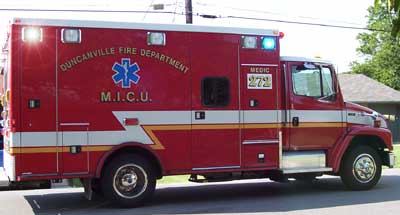
No.
There are many variations.
See: EMS & The
Fire Service
Why do firefighters
wear red suspenders?
To
hold their pants up. (Please stop asking.)
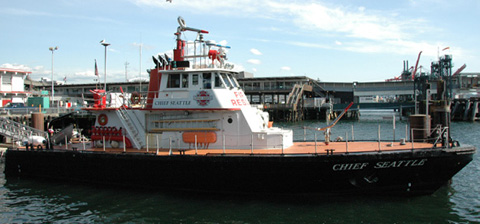
Fire Boat, "Chief Seattle" Seattle FD - Click on photo for more.
How do fire boats work?
When
someone says "fire boats" we often we think
of the vessels that can draft very large quantities
of water from the ocean or other bodies of water.
These pieces of equipment can supply many thousands
of gallons of water a minute. They can fight fire
directly or supply water to land based apparatus.
This is also often the generic name for any watercraft
operated by the fire dept. It may be a small raft
or outboard used for rescues or ferrying equipment
to a location only reachable by water to a slightly
larger boat with a portable engine pump up to an
ocean going tugboat capable of pumping the equivalent
of 20 land based pumpers. Barges or large rafts are
sometimes used to carry several portable or trailer
pumps ranging from 100 gpm to 10,000 gpm each, were
used extensively in England during WWII.
Uses besides rescue work include:
- Providing
large capacity water streams on the fire;
- Supplementing
limited or replacing damaged water mains at large
fires;
- Reaching
areas inaccessible by mobile fire apparatus
such as islands, swamps or the waterfront
side of docks and piers;
- Shipboard
firefighting.
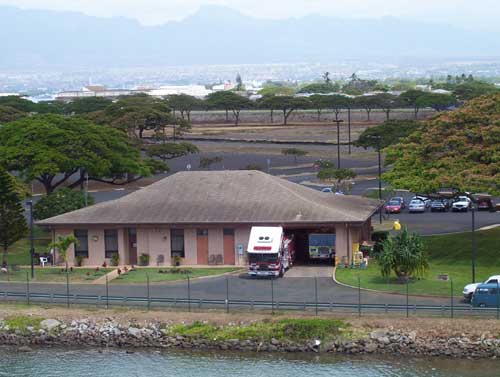
Ford Island, Pearl Harbor Navy Base, Photo taken from The USS
Missouri
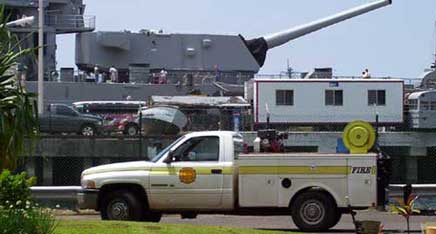
Ford Island (Pearl Harbor Navy Base) Fire Department,
(The
Battleship Missouri in the background.)
How do military fire departments
work?
Military
departments are often a combination of military personnel
and civilians. Of course this depends upon the situation.
There will be less civilians in a war zone than at
a military base in the states. Some bases may have
only civilian personnel. Some may have only military.
Update: Having said that there are fewer civilian
firefighters in a combat zone, I should probably
correct something. At this moment there are hundreds
of civilian firefighters in Iraq who are employed
by the U.S. There are approximately 30 fire stations
being operated by a U.S. company in that combat zone. One of the biggest overseas contractors for firefighters is currently KBR. Another company is Wackenhut (WSI).
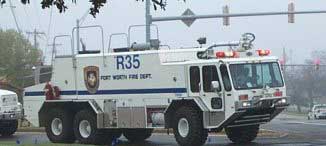
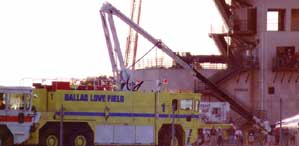
How do those big fire trucks at airports differ from municipal fire apparatus?
First
off, they are not "trucks". They are pumpers
or rescue vehicles.
They can differ in several ways from a regular engine or pumper.
- They
usually can carry and pump larger amounts of water
or foam.
- They
can usually direct foam or water, from a turret
mounted nozzle, from inside the cab.
- They
may have a boom that extends out from the vehicle
to enable them to put foam exactly where they want
it.
What is the National Fire Academy?
In
1974 a Federal law was passed establishing a National Fire
Academy. This facility offers training to mostly
fire officers. Since 1975 over one million students
have received training here. It is a part of FEMA.
Recently, FEMA and the academy have been placed under
the Department of Homeland Security. Students receive
training in anti-terrorism as well as other classes.
The classes offered are very diverse. Not all classes
are taught at the campus in Emmitsburg, Maryland.
Courses are offered all over the US through extension
services
and fire departments. There are even online courses.
For more information:http://www.usfa.fema.gov/fire-service/nfa/nfa.shtm
Why
do even some small fire departments have apparatus
numbers that are two or three digits?
This
could be for any one of a number of reasons.
-
The
entire county or mutual aid system may be on
one numbering system. For example, a smaller
city may
have the numbers 250-270 for their use. This
way communications are not confused at large
fires.
Without such a system there may be three companies
called "Engine 1" at the same fire.
See example below. (Note: This may be a voluntary
program
so you may see both numbering systems in the
same county or at the same fire.)
-
A
city may have several engines at one station.
For example, if Station 5 has three engines,
they may
be numbered, "Engine 51", "Engine
52" and "Engine 53".
-
A
city may have stations numbering 1-5 but also
have a "Central Fire Station". The apparatus
at this station might be numbered "11" or
something else.
-
Traditional
fire apparatus numbering did not allow the use
of a "0" for identification. For decades,
apparatus was dispatched by ringing a bell. A "box" or
a piece of equipment was identified by a series
of bells. A signal of 2 bells then 3 bells meant
box or station 23. They did not have a way to ring
a "0". They also did not want to ring
nine times so the largest number of bells was five
or six. This means that you could not ring a "7".
After five or six the number might be "1-1" Strange
(but very efficient) numbering systems and codes
evolved from this.
-
Chief
officers will often have three digit numbers.
This is often derived from the number the city
has designated
for the fire department. If the fire department
is "Department 5" to the city government,
then the chief of that department will be "500".
Assistant chiefs will be "501", "502" etc.
In some cities the vehicle numbers will reflect
the department number. The engine from Station
1 might be called "Engine 501" or even "Engine
511". You never know.
-
There
are other numbering systems as well.
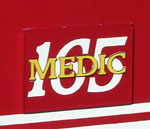
The
number above is from the Lewisville (TX) Fire Department.
This does not mean that they have 165 MICUs.
They participate in a large mutual aid system. The 160's belong to Lewisville.
It is from Station #5. All companies from this station will have the number
165.
There might be a "Ladder 165", "Brush 165" and an "Engine
165".
http://www.cityoflewisville.com
Some
departments have "Kelly Days". What is
that and where did the term come from?
Labor
laws establish how many hours a worker can work,
in a given period, before the employer is required
to pay overtime. For firefighters this amount is
set at 53 hours a week. This does not mean that a
firefighter gets overtime pay the instant he or she
works over 53 hours in a week. For a 24/48 schedule
this would amount to 19 hours of OT every third week
because on two weeks the firefighter would work 48
hours but on the third it would be 72. This amount
can be an average of hours in a set time period.
But even this would an be average of 56 hours a week.
Something must be done to avoid paying that 3 hours
a week overtime. (Although some departments do just
pay it.) Many departments use a four week pay period.
As long as the firefighter does not average over
53 hours a week, in that period, the employer is
within the law.
Confused
yet?
What
usually occurs is that over a four week period about
12 hours of time is accrued. That is then matched
with 12 hours of vacation or a holiday for a complete
shift off. This amounts to getting about every 9th
shift off. But this is not always the case. Some
departments may choose a different schedule. In some
departments, the union negotiates a contract that
includes certain days off. For whatever reason, this
is just a predictable time off from your regular
shift.
Where did
the name come from? This is a question we get
often.
One "legend" is
that there once was a worker who always took off
(sick?) a particular day. Perhaps this was the Monday
after he was paid for the month. Or it could have
been based upon some other regular, predictable,
event. The legend then goes on to suggest that this
person's name WAS "Kelly". From that, the
term was applied to a day off taken. "I'm taking
a day off like Kelly." became "I am taking
a Kelly day." Other legends have the chief who
invented it named Kelly. Members of several
departments have contacted me and proclaimed
that it was in their city that the term was born.
One has it named for a chief who "invented" it.
Another says it was named for a mayor. I have had
one person say that it went back to a specific person,
named Kelly, in Ireland. We get more emails about
this than just about any other subject.
The
most insistent group are those who claim that it
is named for a Chicago Mayor, Edward Kelly. Mayor
Kelly was the son of a Chicago firefighter. The CFD
had endured many hardships due to the depression
and the bad blood between unions and business. Around
1936 Mayor kelly changed the firefighter's schedule
to give them an extra day off. Mayor Kelly was so
loved by the fire department for this and other improvements
to wages and benefits that he was named an honorary
firefighter. To read more about the history of the
CFD, we strongly recommend this site. http://www.affi-iaff.org/history2.html
Some
departments who use Kelly Days:
http://www.edmondsfire.org/fire/DeptOverview.htm
http://www.tampagov.net/dept_fire/Administration/division_summaries.asp
What
is a multi-alarm fire? As in,"The fire was
3 alarms."
It goes back to the Joker Box system or probably before. See:Joker
Box system
In simple terms it is how many times the fire commander, on the scene, has
called for help.
When a citizen reports a structure fire a predetermined response of firefighters
and equipment is sent. This is usually something like: 3 Fire engines, a truck
or two, and a battalion chief. Some cities will also send an MICU on the first
alarm.
If
the commander on the scene determines that more resources
are needed he may call for a second alarm. This provides
another predetermined response. This is usually slightly
less than the "First Alarm". It might be
two engines and a truck. Often a second Battalion
chief is sent along with a district or assistant
chief. Certain other support vehicles also might
automatically be sent on the second alarm. Examples
might be an R&R or Air filling vehicle. Subsequent
alarms will get a similar response.
It
is not uncommon for you to hear a first arriving
fire officer to say, "Give me a second and third
alarm for this fire." This means he wants that
many resources on the way. (Remember the third alarm
response companies are a long way off. They could
be 15 minutes away. In some communities, they are
an hour or more from arrival.)
A
scene commander can special order any type or number
of equipment. He might call for another truck or
just for air. He might ask for several pumpers to
fight a grass fire. It is not uncommon for four engines
to be fighting the same brush fire. This does not
constitute even a first alarm unless he stated, for
some reason, that he wanted a first alarm response.
Some
departments may have special types of first alarm
responses. Examples might include:
- "First alarm Haz Mat response" This may get one Haz Mat Team and
some predetermined support people.
- "First alarm brush response." This might get a certain number of
vehicles, and support personnel, for fighting wildland fires.
Both
of the above may have second alarm versions also.
Why
is it called "turnout gear"?
Great
question.
It should probably just be called "turnout". To use the term "turnout
gear" is possibly redundant. That is like saying "equipment tools." Turnout
can simply mean gear, or equipment.
Roget's
Thesaurus gives Synonyms of 'turnout' as.
"Things needed for a task, journey, or other purpose: accouterment (often
used in plural), apparatus, equipment, gear, material (used in plural), materiel,
outfit, paraphernalia, rig, tackle, thing (used in plural)."
Some readers gave their opinion on this.
Here is one such response.
From Capt. Baland
"Here's something of what I've told folks before, when asked that.
The term is used around Society, for various things, like 'how/what was last
night's turn-out'. It's roots go back ages, for that kind of meaning, as in
attending a thing, etc. Now that can also be used in our settings as well.
And I do use some of these terms sometimes (troopies think I'm funny anyway,
haha), just so troops hear and keep terms in the Industry. I definitely like
using them when instructing somewhere. So, I'll say '....when we turnout for
a ....' or something like that, so it's heard in conjunction with the activity.
There are uses however, where the term has been used for various gear and stuff,
in horse and buggy days. If this was common speak then, it was most likely
adopted or adapted both for responding, AND for the responder's stuff (stuff:
my technical term)."
-----
We also looked up the word in a dictionary. It had several meanings.
Look at definitions #1, #6, #10 & #11. They seem to apply to the fire service.
-turnout, noun.
1. a gathering of people; assemblage.
Ex. There was a good turnout at the picnic.
2. the quantity produced, as by an industry, shop, or machine; total product;
output; yield.
3. a wide place in a narrow road, where vehicles can pass.
4. a similar place in a canal.
5. a railroad siding.
6. the way in which somebody or something is equipped;
equipment; outfit.
7. a horse or horses and carriage; driving equipage.
8. the action of turning out.
9. (British Terms.) a. a strike. b. a worker on strike; striker.
10. the act of getting out (of bed or a barracks).
11. a call to duty, especially during one's period of rest.
12. (Ballet.) a position in which the legs are completely turned outward, the
feet forming a straight line with heels together.